


2026 Hyundai Tucson vs. 2026 Nissan Rogue Comparison
If you are shopping for a compact SUV in Ocean County, the 2026 Hyundai Tucson and 2026 Nissan Rogue are two vehicles worth putting on the same test-drive list. Both seat five and offer available all-wheel drive, but they take different approaches to cargo space, technology, transmissions, towing, and long-term warranty coverage.
The numbers tell part of the story. The Tucson offers more maximum cargo volume, a larger standard touchscreen, a conventional eight-speed automatic transmission, a higher available towing rating, and longer powertrain coverage. The Rogue counters with a 201-horsepower turbocharged three-cylinder engine, a continuously variable transmission, and strong fuel economy for the segment.
The short version: the 2026 Tucson gives you more cargo capacity, a larger standard touchscreen, a conventional eight-speed automatic, higher maximum towing capacity, and a longer powertrain warranty. The 2026 Rogue delivers 201 horsepower and strong EPA fuel economy, and its CVT can feel smooth and relaxed in stop-and-go traffic. Neither is automatically right for everyone, so drive both.
2026 Tucson vs. Rogue at a Glance
The biggest differences become easier to see when the two compact SUVs are placed side by side.
More Cargo Room
The Tucson offers up to 80.3 cubic feet of maximum cargo volume compared with 74.1 cubic feet in the Rogue.
More Standard Screen
Every 2026 Tucson trim uses a 12.3-inch touchscreen, while the Rogue starts with an 8-inch display.
Longer Powertrain Coverage
Hyundai provides 10 years or 100,000 miles of powertrain coverage for original owners versus Nissan's 5 years or 60,000 miles.
2026 Hyundai Tucson vs. 2026 Nissan Rogue: Specifications
Manufacturer figures published as of August 2026. Exact equipment and pricing can vary by trim.
| Specification | 2026 Hyundai Tucson | 2026 Nissan Rogue |
|---|---|---|
| Starting MSRP | $29,450 | $28,850 |
| Seating capacity | 5 | 5 |
| Engine | 2.5L GDI/MPI 4-cylinder | 1.5L VC-Turbo 3-cylinder |
| Horsepower | 187 hp | 201 hp |
| Transmission | 8-speed automatic | Xtronic CVT |
| Drivetrain options | Front-wheel drive or HTRAC all-wheel drive | Front-wheel drive or Intelligent All-Wheel Drive |
| EPA combined MPG | 28 MPG FWD / 26 MPG AWD | 33 MPG FWD / 31 MPG AWD |
| Cargo behind rear seats | 41.2 cu. ft. maximum | 36.5 cu. ft. maximum |
| Maximum cargo volume | 80.3 cu. ft. | 74.1 cu. ft. |
| Passenger volume | 108.2 cu. ft. | 105.4 cu. ft. |
| Standard touchscreen | 12.3 inches | 8 inches |
| Front USB-C charging | Dual USB-C ports standard | USB ports standard; configuration varies by trim |
| Second-row charging | Dual USB-C charging ports standard | Available depending on trim |
| Maximum towing | Up to 2,750 lbs. when properly equipped | Up to 1,500 lbs. |
| Basic warranty | 5 years / 60,000 miles | 3 years / 36,000 miles |
| Powertrain warranty | 10 years / 100,000 miles for original owners | 5 years / 60,000 miles |
Interior and Cargo Space
The Tucson has the advantage when the rear seats and cargo area become part of your daily routine.
The 2026 Tucson offers up to 80.3 cubic feet of maximum cargo volume, compared with 74.1 cubic feet in the Rogue. With the rear seats upright, Hyundai lists up to 41.2 cubic feet of maximum cargo volume, while Nissan lists about 36.5 cubic feet for the Rogue. That difference is useful when you are carrying a stroller, sports equipment, groceries, luggage, or beach gear without folding the second row.
Passenger volume also favors the Tucson at 108.2 cubic feet versus 105.4 cubic feet in the Rogue. Both are five-passenger compact SUVs with usable second rows, so this is not a situation where one vehicle suddenly becomes a three-row substitute. The practical difference is simply that the Tucson gives you a little more room to work with. If you regularly carry a dog crate, golf clubs, hockey equipment, or large shopping loads, bring that item with you and test the actual cargo area.
Technology and Connectivity
Standard equipment matters more than the biggest screen you can get on the highest trim.
The 2026 Tucson makes a strong statement at the base level: every trim receives a 12.3-inch touchscreen, along with wireless Apple CarPlay and Android Auto. The Rogue starts with an 8-inch NissanConnect touchscreen, although a 12.3-inch display becomes available on higher trims. That means shoppers need to compare the actual trims being quoted rather than simply comparing the largest screen each model offers.
The Tucson also includes dual front USB Type-C ports and dual second-row USB charging ports as standard equipment. Rogue USB configurations vary by trim. For a family SUV, those small differences can become surprisingly important when multiple passengers are charging phones, tablets, or other devices on a long drive.
Performance and Drivetrain
The two SUVs take noticeably different approaches to power delivery.
The Tucson uses a 187-horsepower 2.5-liter four-cylinder engine paired with an eight-speed automatic transmission. Front-wheel drive is standard on applicable configurations, with HTRAC all-wheel drive available. The Rogue uses a 201-horsepower 1.5-liter variable-compression turbocharged three-cylinder engine and an Xtronic CVT, with front-wheel drive or Intelligent All-Wheel Drive available.
The Rogue has the horsepower advantage and the fuel-economy advantage. Nissan lists up to 33 MPG combined for the front-wheel-drive Rogue, while the Tucson is rated up to 28 MPG combined in FWD form. The Tucson's eight-speed automatic, however, provides the more traditional geared automatic feel. If you spend a lot of time in stop-and-go traffic, you may prefer the smoothness of the Rogue's CVT; if you prefer to feel conventional gear changes during acceleration, the Tucson is worth driving.
Towing is a different story. The Tucson can tow up to 2,750 pounds when properly equipped, compared with 1,500 pounds for the Rogue. If your weekend plans include a small utility trailer, personal watercraft, or other light recreational equipment, that difference is significant enough to affect the decision.
Warranty and Long-Term Ownership
Warranty coverage becomes more important the longer you plan to keep the SUV.
Hyundai covers the 2026 Tucson with a 5-year/60,000-mile new vehicle limited warranty and a 10-year/100,000-mile powertrain warranty for original owners. Nissan's 2026 Rogue coverage is 3 years/36,000 miles for basic coverage and 5 years/60,000 miles for the powertrain. Terms and conditions apply; see Hyundai warranty details.
If you trade vehicles every three years, the warranty difference may never become particularly important because both vehicles remain within their respective coverage periods. If you plan to keep the SUV for eight or ten years, the difference becomes much more meaningful. The Tucson's powertrain coverage extends well beyond the point where the Rogue's factory powertrain warranty has ended.
Which One Fits Ocean County Driving?
Local driving conditions can make a difference that a national comparison does not always capture.
For drivers in Toms River, Bayville, and Beachwood, the choice will probably come down to how you use the cargo area, how you prefer the transmission to feel, and whether fuel economy or towing matters more. Families carrying beach equipment, sports gear, strollers, or large grocery loads have a practical reason to favor the Tucson's additional cargo space.
Drivers in Whiting and Manchester Township who spend a lot of time on Route 70, Route 530, or longer highway commutes should also consider the Tucson Hybrid before settling on either gas model. If you tow a small trailer or personal watercraft to the bay, the Tucson's higher towing capacity deserves serious consideration. And if winter traction is important, test-drive the available AWD versions of both rather than assuming one is automatically better.
Frequently Asked Questions
Common questions about the 2026 Hyundai Tucson and 2026 Nissan Rogue.
- Is the 2026 Hyundai Tucson better than the 2026 Nissan Rogue?
- The Tucson has advantages in cargo capacity, standard touchscreen size, maximum towing capacity, and warranty coverage. The Rogue offers more horsepower and stronger EPA fuel-economy ratings. Which is better depends on whether you prioritize space and long-term coverage or efficiency and the Rogue's driving character.
- Which has more cargo space, the Tucson or the Rogue?
- The 2026 Hyundai Tucson offers up to 80.3 cubic feet of maximum cargo volume compared with up to 74.1 cubic feet in the 2026 Nissan Rogue. With the rear seats upright, the Tucson also offers more maximum cargo volume.
- Does the Hyundai Tucson tow more than the Nissan Rogue?
- Yes. The 2026 Tucson can tow up to 2,750 pounds when properly equipped, while the 2026 Rogue is rated for up to 1,500 pounds. Always verify the exact equipment, trailer weight, and vehicle rating before towing.
- Which has better fuel economy, the Tucson or Rogue?
- The 2026 Nissan Rogue has the fuel-economy advantage among the gas models. Nissan lists up to 33 MPG combined for the FWD Rogue, while the FWD Tucson is rated at 28 MPG combined. AWD versions are rated lower for both vehicles.
- Where can I test drive a Hyundai Tucson near Toms River?
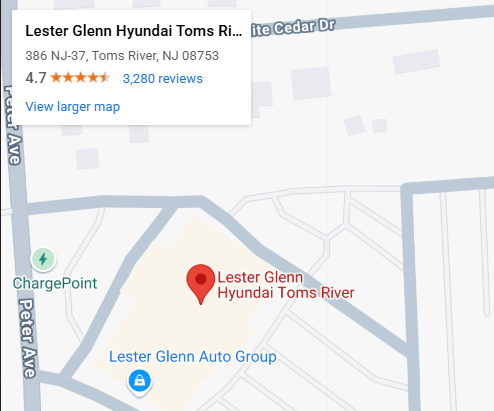
- You can test drive the 2026 Hyundai Tucson at Lester Glenn Hyundai, 386 Route 37 East in Toms River, NJ 08753. Schedule a test drive online or call 732-966-9723. Ask about comparing the Tucson with the Tucson Hybrid as well.
Drive the 2026 Hyundai Tucson in Toms River
See our new Tucson inventory,
compare the Tucson Hybrid,
schedule a test drive,
or check current Tucson offers.
Lester Glenn Hyundai, 386 Route 37 East, Toms River, NJ 08753. Sales: 732-966-9723
Specifications reflect manufacturer figures published as of August 2026 and are subject to change. Cargo and passenger volume figures are maximums and vary by trim and configuration. EPA estimates are for comparison purposes only and actual mileage will vary. Towing capacity requires proper equipment and should never exceed the rating in the owner's manual. Warranty terms and conditions apply; see dealer for details. Lester Glenn Hyundai is not affiliated with Nissan.
Lester Glenn Hyundai
Address
386 Route 37 E
Toms River, NJ 08753
Phone
- Sales 732-966-9723732-966-9745
- Service 732-966-9730
- Parts 732-966-9882
| Monday | 9:00AM - 8:00PM |
| Tuesday | 9:00AM - 8:00PM |
| Wednesday | 9:00AM - 8:00PM |
| Thursday | 9:00AM - 8:00PM |
| Friday | 9:00AM - 8:00PM |
| Saturday | 9:00AM - 6:00PM |
| Sunday | Closed |
| Monday | 7:00AM - 5:00PM |
| Tuesday | 7:00AM - 5:00PM |
| Wednesday | 7:00AM - 5:00PM |
| Thursday | 7:00AM - 5:00PM |
| Friday | 7:00AM - 5:00PM |
| Saturday | 7:00AM - 5:00PM |
| Sunday | Closed |
| Monday | 7:00AM - 4:00PM |
| Tuesday | 7:00AM - 4:00PM |
| Wednesday | 7:00AM - 4:00PM |
| Thursday | 7:00AM - 4:00PM |
| Friday | 7:00AM - 4:00PM |
| Saturday | 7:00AM - 4:00PM |
| Sunday | Closed |