


2026 Hyundai Elantra vs. 2026 Nissan Sentra Comparison
The compact sedan is still a smart choice for Ocean County drivers who want affordable transportation, easy parking, good fuel economy, and a lower price than many comparable SUVs. The 2026 Hyundai Elantra and all-new 2026 Nissan Sentra are two of the most direct choices in this class. They start within $25 of each other, both seat five, and both offer modern technology and driver-assistance features. The bigger differences are in powertrain variety, fuel economy, interior packaging, technology by trim, and warranty coverage.
The short version: the Elantra gives shoppers more powertrain variety, including a 54-MPG hybrid and the 201-hp N Line, plus Hyundai's longer 10-year/100,000-mile powertrain warranty for original owners. The redesigned Sentra counters with a standard 12.3-inch touchscreen, strong highway fuel economy, and an upgraded interior with available 12.3-inch digital instrumentation. Both deserve a test drive.
2026 Hyundai Elantra vs. 2026 Nissan Sentra: specifications
Swipe left and right to view the full comparison.
| Specification | 2026 Hyundai Elantra | 2026 Nissan Sentra |
|---|---|---|
| Starting MSRP | $22,625 | $22,600 |
| Seating capacity | 5 | 5 |
| Base engine | 2.0L 4-cylinder | 2.0L 4-cylinder |
| Base horsepower | 147 hp | 149 hp |
| Transmission | Intelligent Variable Transmission (IVT) | Xtronic CVT |
| Drivetrain | Front-wheel drive | Front-wheel drive |
| EPA combined MPG | Up to 35 MPG gas; up to 54 MPG Hybrid Blue | Up to 33 MPG |
| Hybrid version available | Yes — Elantra Hybrid | No |
| Performance version | Elantra N Line: 201 hp | SR is the sport-oriented trim; no separate high-performance model |
| Rear legroom | 38.0 inches | 34.8 inches |
| Trunk volume | 14.2 cubic feet | 14.3 cubic feet |
| Passenger volume | 99.4 cubic feet | Manufacturer specifications list interior dimensions; passenger-volume figure is not presented in the same format |
| Standard touchscreen | 8-inch display audio | 12.3-inch NissanConnect touchscreen |
| Available digital instrument display | 10.25-inch on higher trims | 12.3-inch on SV, SR and SL |
| Apple CarPlay / Android Auto | Wireless on base trims; wired connection on higher trims depending on configuration | Wireless Apple CarPlay and Android Auto |
| Basic warranty | 5 years / 60,000 miles | 3 years / 36,000 miles |
| Powertrain warranty | 10 years / 100,000 miles for original owners | 5 years / 60,000 miles |
Interior space and comfort
The Elantra has the advantage where rear-seat passengers are most likely to notice it. Hyundai lists 38.0 inches of rear legroom, while Nissan lists 34.8 inches for the redesigned Sentra. That is more than three inches of additional space for passengers in the second row, which is significant in a compact sedan. If you regularly carry adults in the back seat or use a rear-facing child seat, the Elantra's extra room is worth trying in person.
The trunk comparison is much closer. The Elantra provides 14.2 cubic feet of cargo space, while the Sentra lists 14.3 cubic feet. In other words, there is essentially no meaningful cargo-volume winner here. The better test is whether your actual luggage, groceries, sports equipment, or stroller fits the way you need it to. For most buyers, rear-seat space is the more meaningful packaging difference between these two sedans.
Technology and connectivity
This is an area where the redesigned 2026 Sentra deserves real credit. Nissan made a 12.3-inch NissanConnect touchscreen standard, including on the $22,600 S trim. The SV, SR, and SL add a 12.3-inch digital dashboard, while upper trims can add features such as wireless charging, Bose audio, and a larger collection of driver-assistance technology. That gives the Sentra a particularly strong technology story for an entry-level compact sedan.
The Elantra takes a different approach. Its base trims use an 8-inch touchscreen with wireless Apple CarPlay and Android Auto, while higher trims move to a 10.25-inch navigation display and add features such as Bose premium audio, wireless device charging, Bluelink+, and additional convenience equipment. So the Sentra wins the simple “big screen from the start” comparison, while the Elantra gives you a clear path to more premium equipment as you move up the trim ladder.
Powertrain choices
The biggest structural advantage in the Elantra lineup is choice. The conventional 2026 Elantra uses a 2.0-liter four-cylinder producing 147 horsepower, while the Elantra N Line uses a turbocharged 1.6-liter producing 201 horsepower. There is also the Elantra Hybrid, whose Blue trim reaches an EPA-estimated 54 MPG combined. That gives Hyundai shoppers three substantially different ways to buy an Elantra depending on whether the priority is value, fuel economy, or performance.
The redesigned Sentra keeps things simpler. Every 2026 Sentra is front-wheel drive and uses a 2.0-liter four-cylinder with 149 horsepower and 146 lb.-ft. of torque paired with a CVT. EPA estimates reach 33 MPG combined on the S and SV, while SR and SL models are rated at 32 MPG combined. There is no 2026 Sentra hybrid and no separate high-performance Sentra equivalent to the Elantra N.
That difference matters most according to how you drive. If you spend your week commuting from Bayville or Beachwood to Toms River and want to minimize fuel stops, the Elantra Hybrid deserves a serious look. If you simply want an efficient gas sedan and like the redesigned Sentra's technology and interior, its simpler lineup may actually make the decision easier.
Ride and driving character
Both cars are designed first and foremost as comfortable, efficient commuter sedans. The conventional Elantra uses Hyundai's IVT, while the Sentra uses Nissan's Xtronic CVT, so neither is built around traditional stepped automatic transmission behavior. The Elantra lineup becomes more performance-oriented as you move to the N Line, where the 201-hp turbo engine and seven-speed dual-clutch transmission give it a substantially different character from the standard car.
The Sentra's advantage is that the redesigned 2026 model puts more emphasis on refinement and interior presentation without requiring buyers to jump to a larger vehicle. The SR adds sport-oriented styling and 18-inch wheels, but it remains an efficiency-focused compact sedan rather than a dedicated performance model. If driving feel is high on your list, the right comparison is an Elantra N Line against a Sentra SR, followed by an actual test drive rather than a decision based solely on trim names.
Fuel economy: Elantra has the broader advantage
For conventional gas models, both cars are efficient enough for everyday Ocean County commuting. The 2026 Elantra SE reaches 35 MPG combined, while the 2026 Sentra S and SV reach 33 MPG combined. The Elantra N Line drops to 31 MPG combined because of its turbocharged powertrain and seven-speed dual-clutch transmission.
But the Elantra's available hybrid changes the comparison considerably. The 2026 Elantra Hybrid Blue is rated at 51 city, 58 highway, and 54 combined MPG, giving Hyundai shoppers an option the Sentra does not currently offer. For a driver putting substantial mileage on Route 37, Route 9, or the Garden State Parkway, that is a difference worth calculating over the length of ownership.
Warranty and long-term ownership
This is another clear Elantra advantage. Hyundai provides 5 years or 60,000 miles of new-vehicle limited warranty coverage and a 10-year or 100,000-mile powertrain limited warranty for original owners. Nissan provides 3 years or 36,000 miles of basic coverage and 5 years or 60,000 miles of powertrain coverage. Terms and conditions apply; see Hyundai warranty details and confirm current Nissan terms with a Nissan dealer.
If you lease or trade within three years, the difference may never matter to you. If you buy a compact sedan because you intend to keep it for eight or ten years, however, Hyundai's longer powertrain coverage becomes considerably more relevant. It does not eliminate maintenance or guarantee that every repair is covered, but it extends factory powertrain protection well beyond Nissan's five-year term.
Which one fits Ocean County driving?
Both cars make sense for the everyday driving that dominates Toms River, Bayville, Beachwood, Lakehurst, Whiting, and Manchester Township. A compact sedan is easy to maneuver, inexpensive to fuel, and generally easier to park than a comparable SUV. If your daily routine involves Route 37, Route 70, Route 9, or the Parkway, either car can handle the job without the added cost and size of a crossover.
We would point you toward the Elantra if fuel economy, rear-seat space, long-term warranty coverage, or powertrain choice is high on your list. The Elantra Hybrid is especially compelling for high-mileage commuters, while the N Line gives enthusiasts an option the Sentra lineup does not match. The Sentra deserves consideration if you particularly value its redesigned cabin, standard 12.3-inch touchscreen, or the overall way the new model drives. This is a comparison where sitting in both cars and driving both is worthwhile.
Frequently asked questions
- Is the 2026 Hyundai Elantra or 2026 Nissan Sentra a better buy?
- The Elantra has the broader lineup, with gas, hybrid, and N Line versions, plus a longer powertrain warranty for original owners. The redesigned Sentra counters with a standard 12.3-inch touchscreen, a refreshed interior, and competitive fuel economy. The better choice depends on whether efficiency, long-term coverage, or Sentra's technology package matters most to you.
- Does the 2026 Nissan Sentra come as a hybrid?
- No. The 2026 Sentra is offered with a 2.0-liter four-cylinder engine and Xtronic CVT. Nissan does not currently offer a hybrid version of the 2026 Sentra in the U.S. market. If hybrid fuel economy is a priority, the 2026 Hyundai Elantra Hybrid is the relevant alternative.
- Which has more rear-seat space, the Elantra or Sentra?
- The 2026 Hyundai Elantra has more published rear legroom, with 38.0 inches compared with 34.8 inches in the 2026 Nissan Sentra. That difference is noticeable if you regularly carry adult passengers or need extra room around a child safety seat.
- Which has the larger trunk, the Elantra or Sentra?
- The difference is essentially negligible. Hyundai lists 14.2 cubic feet of trunk space for the Elantra, while Nissan lists 14.3 cubic feet for the Sentra. In practical terms, both offer similar trunk capacity, so shoppers should test their own luggage or cargo rather than choosing based on the tenth-of-a-cubic-foot difference.
- How does Hyundai's warranty compare with Nissan's?
- Hyundai provides 5 years or 60,000 miles of new-vehicle coverage and 10 years or 100,000 miles of powertrain coverage for original owners. Nissan provides 3 years or 36,000 miles of basic coverage and 5 years or 60,000 miles of powertrain coverage. Terms and conditions apply.
- Where can I test drive a Hyundai Elantra near Toms River?
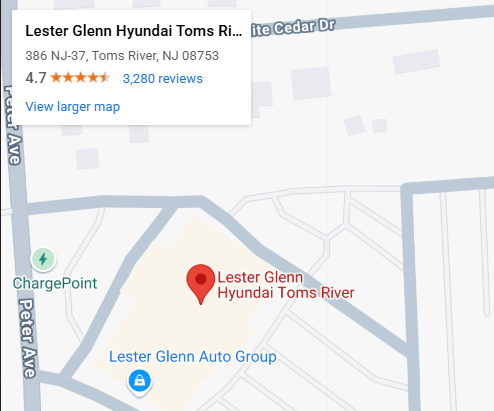
- At Lester Glenn Hyundai, 386 Route 37 East in Toms River, NJ 08753. We serve drivers throughout Toms River, Bayville, Beachwood, Whiting, Manchester Township, Lakehurst, and surrounding Ocean County communities. Schedule a test drive online or call 732-966-9723.
Drive the 2026 Hyundai Elantra in Toms River
See our new Elantra inventory, explore the Elantra Hybrid, or check out the Elantra N. You can also view current Elantra offers or schedule a test drive.
Lester Glenn Hyundai, 386 Route 37 East, Toms River, NJ 08753.
Sales: 732-966-9723
Also compare: Elantra vs. Kia K4 | All Hyundai model comparisons
Specifications and pricing reflect manufacturer figures published as of August 2026 and are subject to change. MSRP excludes applicable destination, tax, title, license fees, options, and dealer charges. Figures compare the current 2026 model-year vehicles and may vary by trim or configuration. EPA estimates are for comparison purposes only and actual mileage will vary based on driving conditions, vehicle configuration, driving habits, and other factors. Warranty terms and conditions apply; see dealer for details. Lester Glenn Hyundai is not affiliated with Nissan.
Lester Glenn Hyundai
Address
386 Route 37 E
Toms River, NJ 08753
Phone
- Sales 732-966-9723732-966-9745
- Service 732-966-9730
- Parts 732-966-9882
| Monday | 9:00AM - 8:00PM |
| Tuesday | 9:00AM - 8:00PM |
| Wednesday | 9:00AM - 8:00PM |
| Thursday | 9:00AM - 8:00PM |
| Friday | 9:00AM - 8:00PM |
| Saturday | 9:00AM - 6:00PM |
| Sunday | Closed |
| Monday | 7:00AM - 5:00PM |
| Tuesday | 7:00AM - 5:00PM |
| Wednesday | 7:00AM - 5:00PM |
| Thursday | 7:00AM - 5:00PM |
| Friday | 7:00AM - 5:00PM |
| Saturday | 7:00AM - 5:00PM |
| Sunday | Closed |
| Monday | 7:00AM - 4:00PM |
| Tuesday | 7:00AM - 4:00PM |
| Wednesday | 7:00AM - 4:00PM |
| Thursday | 7:00AM - 4:00PM |
| Friday | 7:00AM - 4:00PM |
| Saturday | 7:00AM - 4:00PM |
| Sunday | Closed |